Cheapest LLM API in 2026: Real Cost per 100,000 Requests
GPT-5 Nano is the cheapest chat model on TokenRex at $0.05 per 1M input tokens, but hidden reasoning tokens can flip the ranking. Real costs for 4 workloads.
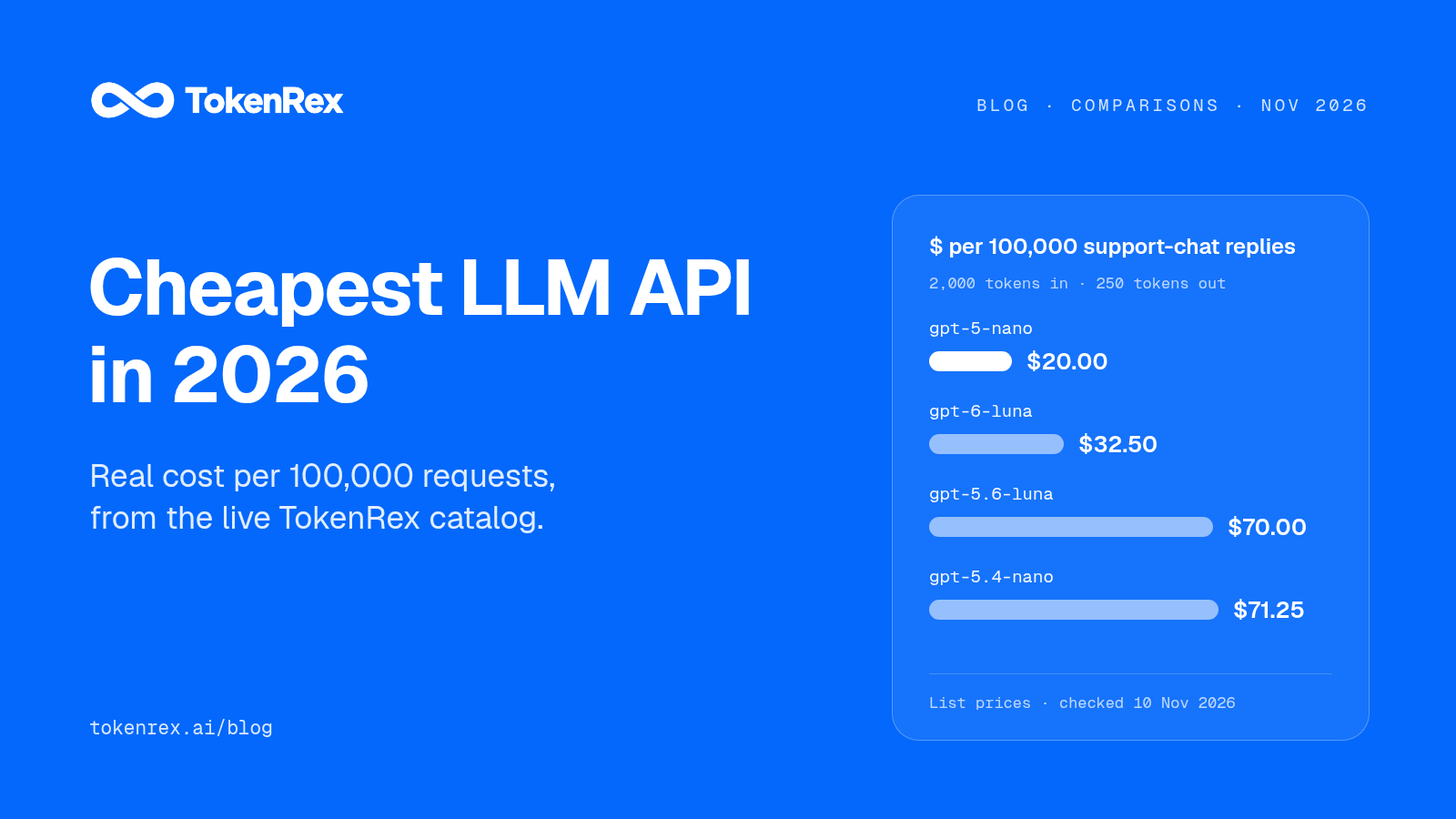
The cheapest chat model on TokenRex right now is GPT-5 Nano, at $0.05 per million input tokens and $0.40 per million output tokens. GPT-6 Luna and GPT-5.6 Luna come next. For 100,000 typical support-chat replies, the three cost $20.00, $32.50 and $70.00 at list price.
The price list is not the bill, though. Most cheap models are reasoning models, and the thinking tokens you never see are billed as output. On a short classification task, 1,000 hidden reasoning tokens per request make GPT-5 Nano about as expensive as Claude Haiku 4.5 with no reasoning at all.
We ranked the cheapest chat models in the live TokenRex catalog (49 chat models at the time of writing) on four common workloads, and worked out where reasoning tokens flip the ranking. The post ends with how to keep an LLM budget predictable. We did not run quality benchmarks here. Every number is price × tokens, so you can check it yourself.
- Cheapest by list price: gpt-5-nano, then gpt-6-luna, then gpt-5.6-luna. GPT-5 Nano is the cheapest on all four workloads we priced when reasoning is kept low. - Watch hidden reasoning on short tasks: on a 400-token classification prompt, GPT-5 Nano loses its lead over gemini-3-flash-preview (no thinking control listed) at about 482 reasoning tokens per request. - Newer knowledge at a low price: gpt-6-luna has a knowledge cutoff of May 2026 and a 1.05M-token context window. GPT-5 Nano's cutoff is May 2024. - Lower the bill further: set reasoning_effort to "low" on simple jobs, and cache stable prompts. Caching a 1,500-token system prompt cuts GPT-6 Luna's chatbot cost by about 42%. - Skip `-fast` IDs unless latency matters. They cost 1.8× to 2.5× the standard model. - About these prices: all figures are TokenRex list prices, checked on 10 November 2026. Any current TokenRex discount lowers them further; each model page shows today's price.
What are the cheapest LLM APIs right now?#
By list price, the cheapest chat model on TokenRex is GPT-5 Nano at $0.05 per 1M input tokens and $0.40 per 1M output tokens. GPT-6 Luna comes next at $0.10 input and $0.50 output. Behind them, at $0.20–$0.25 input, are GPT-5.6 Luna, GPT-5.4 Nano, Gemini 3.1 Flash-Lite and GPT-5 Mini. The cheapest Claude model, Haiku 4.5, costs $1.00 input.
| Model ID | Input $ / 1M | Output $ / 1M | Cached input $ / 1M | Thinking control (TokenRex) |
|---|---|---|---|---|
gpt-5-nano | 0.05 | 0.40 | 0.005 | Low – High |
gpt-6-luna | 0.10 | 0.50 | 0.01 | Low – Max |
gpt-5.6-luna | 0.20 | 1.20 | 0.02 | Low – Max |
gpt-5.4-nano | 0.20 | 1.25 | 0.02 | Low – XHigh |
gemini-3.1-flash-lite | 0.25 | 1.50 | 0.025 | Low – High |
gpt-5-mini | 0.25 | 2 | 0.025 | Low – High |
gemini-3-flash-preview | 0.50 | 3 | 0.05 | None listed |
gemini-3.8-flash | 0.75 | 3.75 | 0.075 | Low – High |
claude-haiku-4-5 | 1 | 5 | 0.10 | Low – XHigh |
TokenRex list prices from the live catalog, checked 10 Nov 2026. `-fast` variants are excluded. [Live prices for every model →](/models)
Two things in this table matter more than the ranking. First, output usually costs 4 to 10 times as much as input, so a model with cheap input can still be expensive for long answers. Second, the thinking control column shows which models can spend hidden reasoning tokens, which is the cost most price lists leave out.
What do 100,000 requests actually cost?#
To turn per-million prices into a budget, we priced four common workloads at a fixed input and output size. The formula is (input tokens × input price + output tokens × output price) × 100,000 requests.
- Support chat reply: 2,000 tokens in (system prompt plus recent history), 250 tokens out.
- Ticket classification: 400 tokens in, 5 tokens out (a single label).
- Document summary: 30,000 tokens in (roughly a 50-page report), 600 tokens out.
- Long-form writing: 500 tokens in, 1,500 tokens out.
| Model ID | Support chat | Classification | Document summary | Long-form writing |
|---|---|---|---|---|
gpt-5-nano | $20.00 | $2.20 | $174.00 | $62.50 |
gpt-6-luna | $32.50 | $4.25 | $330.00 | $80.00 |
gpt-5.6-luna | $70.00 | $8.60 | $672.00 | $190.00 |
gpt-5.4-nano | $71.25 | $8.62 | $675.00 | $197.50 |
gemini-3.1-flash-lite | $87.50 | $10.75 | $840.00 | $237.50 |
gpt-5-mini | $100.00 | $11.00 | $870.00 | $312.50 |
gemini-3-flash-preview | $175.00 | $21.50 | $1,680.00 | $475.00 |
gemini-3.8-flash | $243.75 | $31.88 | $2,475.00 | $600.00 |
claude-haiku-4-5 | $325.00 | $42.50 | $3,300.00 | $800.00 |
Cost per 100,000 requests at list price. Hidden reasoning tokens are assumed to be zero here; the next section covers what changes when they aren't.
For a monthly budget: a support bot handling 10,000 chats a day sends about 300,000 replies a month. At list price that comes to about $60.00 a month on GPT-5 Nano, $97.50 on GPT-6 Luna, $262.50 on Gemini 3.1 Flash-Lite and $975.00 on Claude Haiku 4.5. Model your own traffic in the cost calculator or with our chatbot cost guide.
Why is the cheapest model on the price list not always the cheapest per request?#
Reasoning models think before they answer, and you pay for those thinking tokens at the output rate even though you never see them. On short prompts the visible answer is tiny, so reasoning can dominate the bill:
| Hidden reasoning tokens per request | GPT-5 Nano cost per 100,000 classifications | Compared with zero reasoning |
|---|---|---|
| 0 | $2.20 | 1.0× |
| 50 | $4.20 | 1.9× |
| 250 | $12.20 | 5.5× |
| 1,000 | $42.20 | 19.2× |
Ticket classification: 400 tokens in, 5 visible tokens out. For comparison, Claude Haiku 4.5 costs $42.50 and Gemini 3 Flash Preview costs $21.50 per 100,000 classifications with no reasoning.
Gemini 3 Flash Preview has no thinking control listed in the TokenRex catalog, so the output you pay for is roughly the output you see. That makes it a useful reference point. GPT-5 Nano stays cheaper while its hidden reasoning stays below about 1.1 times your input tokens plus 6.5 times your visible output tokens.
| Workload | Input tokens | GPT-5 Nano stops being cheaper than Gemini 3 Flash Preview at |
|---|---|---|
| Classification | 400 | ~482 reasoning tokens per request |
| Long-form writing | 500 | ~10,312 reasoning tokens per request |
| Support chat | 2,000 | ~3,875 reasoning tokens per request |
| Document summary | 30,000 | ~37,650 reasoning tokens per request |
For long-input jobs like document summaries, GPT-5 Nano's very low input rate almost always wins. For short-prompt jobs like classification, a few hundred reasoning tokens are enough to erase its lead. GPT-6 Luna costs more than GPT-5 Nano on every token type; the reason to pick it is its newer knowledge and larger context window, not its price.
To check your own numbers, send 20–50 real requests and look at the usage object in each response. If completion_tokens is much larger than the visible reply, the difference is reasoning. Some responses also break it out as completion_tokens_details.reasoning_tokens. The per-request cost in your TokenRex dashboard shows the result in money. Our reasoning tokens guide explains the details.
How do you cut the bill further?#
Step 1: Set reasoning effort to low for simple jobs#
On TokenRex, thinking is a request setting, not a separate model. Keep the same model ID and send reasoning_effort: "low" on Chat Completions. The per-token price stays the same; you just pay for fewer thinking tokens.
Step 2: Cache the part of the prompt that never changes#
Put stable content (system prompt, policies, examples) first and the changing user message last. On these models, cached input costs one-tenth of the normal input rate. In the support-chat example, if 1,500 of the 2,000 input tokens come from cache:
| Model ID | Without cache | With 1,500 tokens cached | Saving |
|---|---|---|---|
gpt-5-nano | $20.00 | $13.25 | 34% |
gpt-6-luna | $32.50 | $19.00 | 42% |
gemini-3.1-flash-lite | $87.50 | $53.75 | 39% |
claude-haiku-4-5 | $325.00 | $190.00* | 42% |
Cost per 100,000 replies. Cache hits are not guaranteed, so confirm them in the usage fields. \Claude also bills a one-time cache-write rate ($1.25 per 1M on Haiku 4.5) the first time the prefix is stored. See the prompt caching guide.*
Step 3: Cap output length carefully#
Output is the expensive side, so ask for short, structured answers, such as a JSON label instead of a paragraph. On reasoning models, don't set the output limit too low. Hidden reasoning counts toward the limit, so a tight cap can leave the model without room for the visible answer.
Step 4: Avoid `-fast` IDs unless you need lower latency#
Every -fast ID on TokenRex is priority serving at a higher rate. Gemini fast IDs cost 1.8×, most GPT fast IDs cost 2×, and gpt-5.5-fast costs 2.5×. For batch or background work, use the standard ID.
Step 5: Route cheap first, escalate when needed#
Send every request to a low-cost model first, and retry on a stronger model only when a check fails, such as invalid JSON or low confidence. Our cheap vs premium model test shows how to run that comparison on your own prompts.
Which cheap model should you pick?#
There is no single answer, and we have not measured quality for this post. These rules come from price, context window and catalog data:
- Short, high-volume tasks such as labels, routing, yes/no checks and field extraction: start with
gpt-5-nanoandreasoning_effort: "low", and confirm its reasoning stays well under a few hundred tokens per request on your prompts. If it doesn't, comparegemini-3-flash-preview, which has no thinking control listed. - Long inputs such as reports, contracts or transcripts to summarize:
gpt-5-nanohas the lowest input rate ($0.05 per 1M). Confirm its 400K context window fits your documents and check summary quality on a sample. - Chatbots that need recent knowledge or a very long context:
gpt-6-lunahas a May 2026 knowledge cutoff and a 1.05M-token context window, for $32.50 per 100,000 support replies at list price. - If you need Claude specifically:
claude-haiku-4-5is the cheapest Claude model on TokenRex, at about 10× GPT-6 Luna's cost per support reply. See GPT-6 Luna vs Claude Haiku 4.5.
Before you commit, run 20–50 of your real prompts through two or three of these models and compare the answers next to the cost. Each model page also lists source-linked third-party benchmarks where they exist.
How do you call these models on TokenRex?#
Every model uses the same OpenAI-compatible endpoint and one API key, so switching models is a one-line change.
curl https://tokenrex.ai/api/public/v1/chat/completions \
  -H "Authorization: Bearer $TOKENREX_API_KEY" \
  -H "Content-Type: application/json" \
  -d '{
    "model": "gpt-5-nano",
    "reasoning_effort": "low",
    "messages": [
      {"role": "system", "content": "Classify the ticket as billing, bug or other. Reply with one word."},
      {"role": "user", "content": "I was charged twice for my last top-up."}
    ]
}'import os
from openai import OpenAI
client = OpenAI(
api_key=os.environ["TOKENREX_API_KEY"], # keep the key on your server
base_url="https://tokenrex.ai/api/public/v1",
)
resp = client.chat.completions.create(
model="gpt-5-nano", # swap to "gpt-6-luna" or "gemini-3.1-flash-lite" to compare
messages=[
{"role": "system", "content": "Classify the ticket as billing, bug or other. Reply with one word."},
{"role": "user", "content": "I was charged twice for my last top-up."},
],
)
print(resp.choices[0].message.content)
print(resp.usage) # check completion_tokens to see what you were billed forGPT, Gemini and Claude models all draw from one prepaid TokenRex balance. You don't need a separate account and invoice with each provider.
Frequently asked questions#
What is the cheapest LLM API in 2026?#
On TokenRex, the cheapest chat model by list price is GPT-5 Nano (gpt-5-nano), at $0.05 per million input tokens and $0.40 per million output tokens. GPT-6 Luna follows at $0.10 input. Once hidden reasoning tokens are counted, the cheapest model per request can be a different one.
Is GPT-5 Nano cheaper than Gemini 3 Flash Preview?#
On list price, yes, by a wide margin. Per request, it depends on reasoning. On a 400-token classification prompt, GPT-5 Nano stays cheaper until it spends about 482 hidden reasoning tokens per request.
What is the cheapest Claude API model?#
Claude Haiku 4.5 (claude-haiku-4-5) is the cheapest Claude model on TokenRex, at $1.00 per million input tokens and $5.00 per million output tokens. Cached input costs $0.10 per million.
Do reasoning tokens cost extra?#
They are billed at the model's normal output rate. There is no separate fee, but they add to your output token count even though they don't appear in the reply. Setting reasoning_effort to "low" on simple tasks keeps them down.
How do I switch between these models?#
Change the model field in your request. Every TokenRex model uses the same API key and the same OpenAI-compatible endpoint, so you can A/B test GPT, Gemini and Claude models without changing anything else in your code.
Next steps#
- Compare live prices for every model on Models & Pricing, or see the shortlist on Cheapest LLM APIs right now.
- Estimate your monthly bill in the cost calculator or with the startup AI budget guide.
- Head-to-head comparisons: GPT-5.4 Nano vs Gemini 3.1 Flash-Lite · GPT-6 Luna vs Gemini 3.8 Flash · GPT-6 Luna vs Claude Haiku 4.5.
- Workload guides: email classification cost · summarization cost · cheapest LLM for your workload.
- Go deeper: 12 tactics to cut your LLM bill in half · Docs.
- Get an API key and test the three cheapest models on your own prompts.
Prices are TokenRex list prices from the live model catalog, checked on 10 November 2026, before any current discount. Cost = (input tokens × input price + output tokens × output price) ÷ 1,000,000, per request, then multiplied by 100,000. Hidden reasoning is counted as zero unless stated, and `-fast` variants are excluded from the rankings. Context windows and knowledge cutoffs come from TokenRex model pages and are published provider limits. Prices change; each model page always shows the current rate.
Models in this article
Review current prices, specifications and source-linked benchmarks.
Build this with TokenRex
TokenRex is an LLM marketplace by Asirex Labs. Choose an enabled model, create a private API key and use the supported endpoint shown in Docs. Check live prices before your first request.